EMI Calculator
Use this simple EMI Calculator to find your monthly installment, total interest and total payment in seconds.
Tip: Interest is annual. The calculator converts it into a monthly rate automatically.
Enter values on the left and click Calculate EMI to see your results here.
How to Use the EMI Calculator
Type your Loan Amount in rupees. This is the money you plan to borrow.
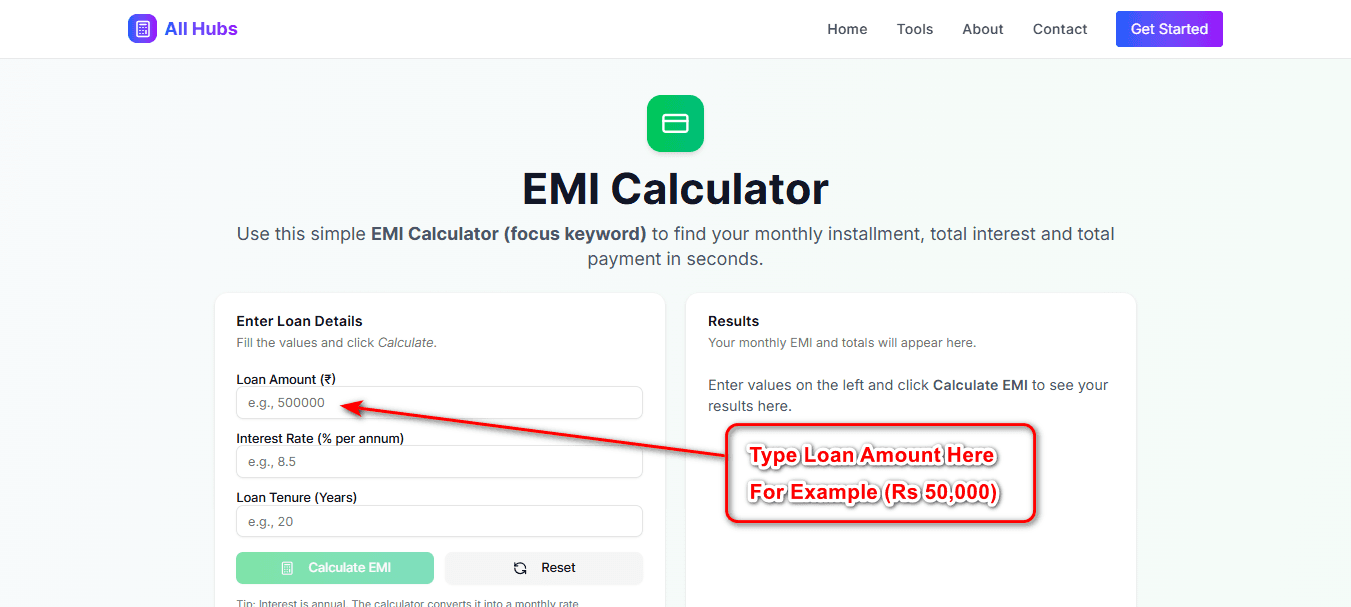
Enter the Interest Rate per year, e.g., 8.5.

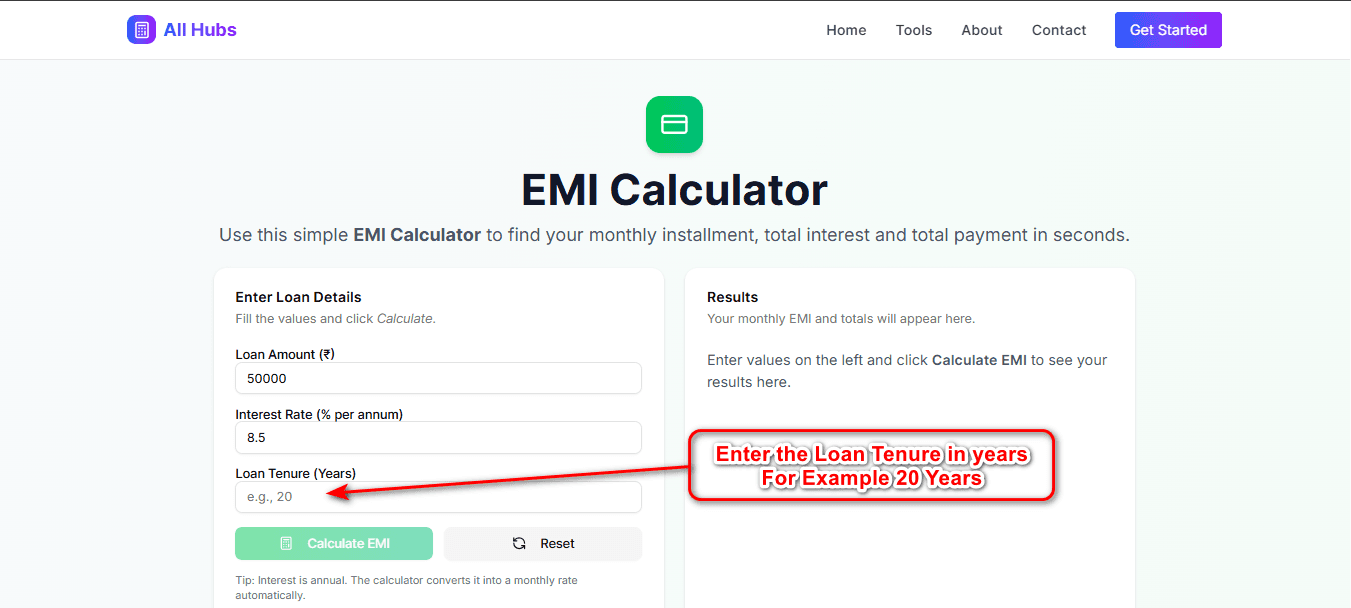
Enter the Loan Tenure in years, e.g., 20. The tool converts it to months.
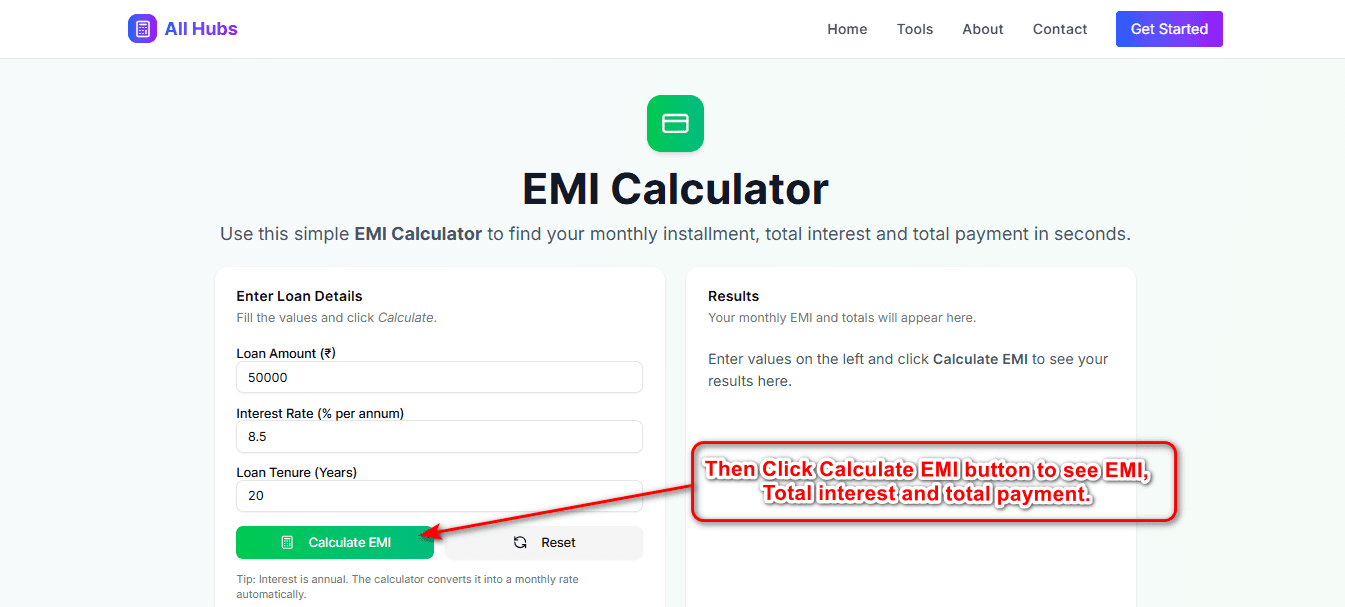
Click the Calculate EMI button to see EMI, total interest and total payment.
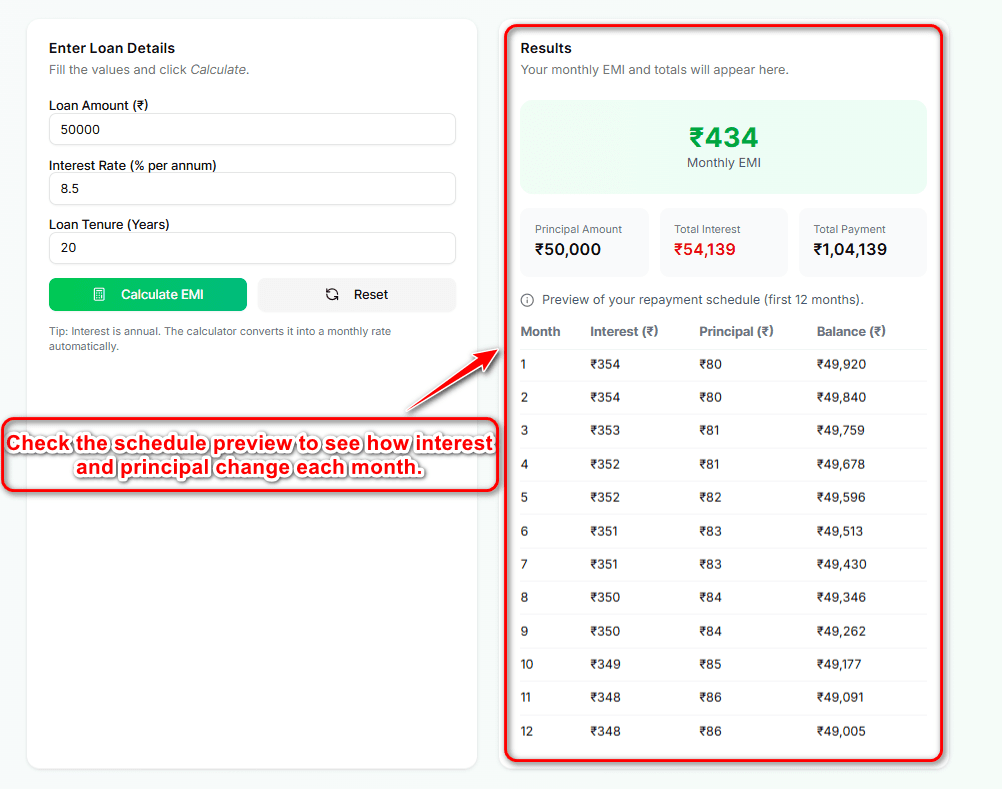
Check the schedule preview to see how interest and principal change each month.
Use Reset to try different values and compare lenders quickly.
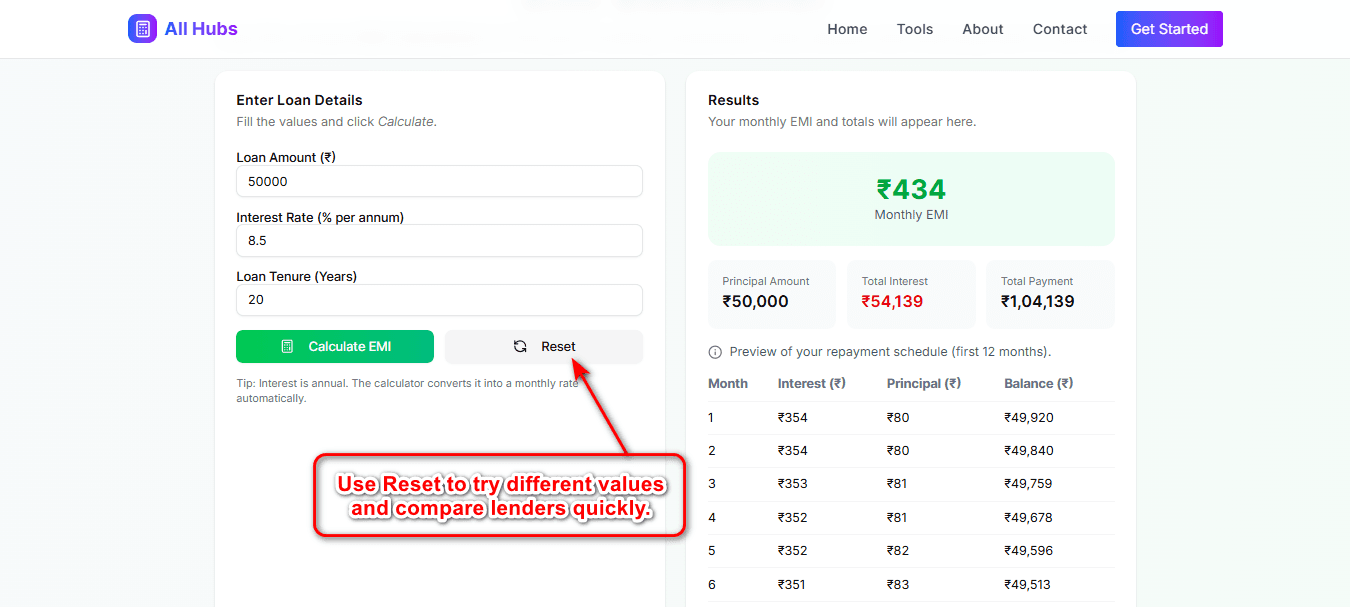
Tip: Change one input at a time to compare lenders easily.
Key Features of the EMI Calculator
Simple inputs and instant results.
Shows monthly EMI, total interest and total payment.
Repayment schedule preview (first year).
Works on mobile, tablet and desktop.
Clean All Hubs design and colors.
No login, no data storage—runs in your browser.
Reset button for side-by-side comparisons.
Helpful tips and FAQs for beginners.
What is EMI and how does it work?
EMI means Equated Monthly Installment. It is a fixed amount that you pay every month to repay a loan. Each EMI has two parts: a part that pays the interest (the cost of borrowing money) and a part that reduces the principal (the original loan). In the first few months, the interest share is usually higher because the outstanding balance is large. As you keep paying, the balance falls and the interest part slowly becomes smaller. This is why the same EMI becomes more “principal-heavy” later in the loan.
Our EMI Calculator shows three numbers that matter most before you sign any loan: the monthly EMI, the total interest payable across the full tenure, and the total payment (principal + interest). These are not just numbers; they are the basis of every practical decision—how much to borrow, which lender to choose, what tenure is safe for your income, and how fast to prepay.
The EMI formula (and the simple intuition behind it)
Banks use a standard formula:
EMI = P × r × (1 + r)n ÷ ((1 + r)n − 1)
P = loan amount, r = monthly interest rate (annual rate ÷ 12 ÷ 100), n = total number of months.
Intuition: the formula spreads your loan into equal monthly chunks in such a way that (1) the balance goes to zero at the end and (2) interest is charged on the current balance every month. You don’t have to do any math yourself—the calculator handles it—but knowing why the EMI stays the same while interest declines helps you understand why early prepayments save more interest than late prepayments.
What truly changes your EMI
- Loan Amount: Higher principal means higher EMI. If you can increase down payment, you instantly reduce both EMI and total interest.
- Interest Rate: Even 0.50% change can move EMI by a noticeable amount on long loans. Rate shopping is worth the time.
- Tenure: Longer tenure = smaller EMI but higher lifetime interest. Shorter tenure = larger EMI but lower lifetime interest.
The smart method is to fix the EMI you can comfortably afford (as a % of income) and then find the right tenure for your chosen loan amount at your lender’s rate. The calculator makes this fast—try a few combinations and aim for safety first.
Fixed vs Floating Interest: a clear, practical comparison
Loans are usually offered with either a fixed rate or a floating (variable) rate.
- Fixed rate: The rate stays the same for most or all of the tenure. EMI is stable and planning is easy. But if market rates fall, you may keep paying the higher old rate unless the contract allows a reset.
- Floating rate: The rate can move with the market. When rates rise, lenders may increase EMI or extend tenure. When rates fall, the opposite happens. Over long periods, floating can become cheaper or costlier depending on the rate cycle.
Decision shortcut: If your income is tight and you cannot handle surprises, a fixed rate gives peace of mind. If you can handle some ups and downs and want the chance to benefit when rates fall, floating is fine—just stress-test the EMI with +1% and +2% rates in the calculator and make sure the EMI still fits.
Choosing the right tenure: a simple playbook
- Find your EMI comfort zone: As a general thumb rule, try to keep total EMIs under 40% of take-home pay (lower is better). If your income is unstable, keep it under 30–35%.
- Start with a safe tenure: Use a tenure that fits your comfort EMI at the current rate (use the calculator). Do not push to the limit.
- Add a stress buffer: For floating loans, check the EMI again with +1% and +2% rates. If it still fits, the tenure is safe.
- Plan prepayments: If you expect yearly bonuses or freelancing bursts, choose a slightly longer tenure for comfort and make early prepayments to kill interest faster.
- Re-optimise yearly: Once a year, recheck the rate and EMI. If rates drop, ask for a reset; if income rises, reduce tenure by prepaying.
Five money rules that make any EMI safer
- Rule 1 — The 40% cap: Keep total EMIs ≤ 40% of take-home pay. If your job/income is unstable, keep it ≤ 30–35%.
- Rule 2 — Build a 3-month buffer: Maintain an emergency fund that covers at least 3 months of EMIs + basics. This protects you from delays or surprises.
- Rule 3 — Pay on time, every time: Late fees and extra interest grow quickly and can hurt your credit score.
- Rule 4 — Prepay early when possible: The first one-third of the tenure is where prepayments save the most interest.
- Rule 5 — Review once a year: Ask for a rate reduction if market rates have fallen. Small rate cuts matter a lot over long tenures.
Stress-testing your EMI (do this before signing)
A quick stress test protects you from “rate shock.” In the EMI Calculator, try these three runs:
- Base case: Use today’s rate and your chosen tenure.
- Mild stress: Add +1% to the rate. Does the EMI still fit your 40% cap?
- Hard stress: Add +2%. If this hurts your budget, consider a longer tenure or a smaller loan amount.
If all three cases pass, your plan is robust. If not, adjust the numbers now rather than later.
Three quick case studies (with lessons you can apply)
Numbers are rounded and simplified for clarity. Try similar runs with your own values in this EMI Calculator.
Case 1 — Same loan, different rates
Loan ₹10,00,000 for 10 years. Compare 9.0% vs 10.0% annual rate. The EMI at 9.0% is lower and the total interest is significantly less than at 10.0%. Lesson: Rate shopping pays. Even a 1% difference is big over long periods.
Case 2 — Same loan, different tenures
Loan ₹10,00,000 at 10% rate. Tenure 7 years vs 10 years. The 10-year EMI is easier each month but the lifetime interest is much higher than the 7-year case. Lesson: If you can handle a slightly bigger EMI safely, shorter tenures save a lot of money.
Case 3 — Early prepayment effect
Loan ₹10,00,000, 10 years, 10%. If you pay one extra EMI every year during the first 3–4 years, the total interest drops sharply and the loan ends earlier. Lesson: Prepay early (even small amounts) because the interest share is highest in the initial years.
Prepayment tactics that actually work
- “1-EMI-extra” rule: Try to pay one extra EMI amount once a year. If that’s hard, pay half an EMI every six months.
- Bonus sweep: When you get bonuses/incentives, sweep a fixed % (say 30–40%) into prepayment before spending.
- Fee check: Some lenders charge prepayment fees on fixed loans. Floating loans often have zero fee for individuals—verify the fine print.
- EMI vs Tenure cut: Ask the lender to reduce tenure after prepayment (keeps EMI same), because that usually saves more interest than lowering EMI.
Balance transfer: when moving to another lender makes sense
You can shift the remaining balance to a new lender at a lower rate. This works best in the early or middle years of the loan. Before deciding, use this checklist:
- New rate is at least 0.50%–1.00% lower than your current effective rate.
- Any transfer fees, processing fee and documentation costs don’t wipe out the benefit.
- Tenure left is reasonably long (so the lower rate applies for many months).
- Credit score and income profile meet the new lender’s rules.
Use this EMI Calculator to compare “stay vs transfer” by running the new rate on the remaining tenure and balance. Choose the option with a lower total interest outflow after including fees.
Fixed vs Floating: deeper analysis for real-life choices
Many websites stop at basic definitions. Here’s the part borrowers actually need:
- Income stability matters: If income is stable and you keep a buffer, floating rate is usually okay. If income is tight or seasonal, fixed rate keeps cash flow predictable.
- Rate cycle awareness: If rates are already very high compared to the last few years, they may fall later—floating can benefit you. If rates are very low, locking a fixed rate for a few years might be safer.
- Hybrid options: Some lenders offer “fixed for first X years, then floating.” This is useful if you want stability early (when your balance is big) and flexibility later.
- Stress-test floating: Always test +1% and +2% on the calculator. If a +2% EMI breaks your budget, either choose fixed or pick a longer tenure to create room.
Down payment strategy: how much is enough?
More down payment reduces the loan amount and interest, but don’t empty your savings. After paying the down payment, you should still have an emergency fund for 3–6 months of living costs + EMIs. If paying a bigger down payment will leave you with no safety net, choose a moderate down payment and keep the buffer intact. What saves you from stress is not just a lower EMI but the ability to handle surprises.
Fees, insurance and the “real” cost of a loan
The EMI formula doesn’t include processing fees, documentation charges or loan insurance. These increase the first-year cost even if the EMI stays the same. While comparing offers, ask for a clean breakup: rate, effective APR, processing fee, insurance premium, prepayment/foreclosure charges, and late payment penalties. Compare the total outflow, not just the rate.
Using this EMI Calculator as a planning tool (not just a number tool)
- Enter a realistic loan amount and today’s rate. Find the EMI.
- Check the EMI-to-income ratio (keep ≤ 40%). If it’s high, try a longer tenure or increase down payment.
- Run +1% and +2% rate scenarios for floating loans. Confirm the EMI still fits your budget.
- Plan prepayment milestones (for example: “one extra EMI every March with bonus”).
- Revisit the plan every year: rate reset, small prepayments, and tenure optimisation.
Small decisions that add up over the years
- Automate EMI payment from a dedicated account to avoid late fees.
- Round up the EMI. Paying ₹500–₹1,000 extra each month is like a mini-prepayment that quietly saves interest.
- When income rises, increase EMI instead of lifestyle spending.
- Keep documents and statements organised; it helps during balance transfer or rate negotiation.
Quick myths about EMIs (and the truth)
- “Longer tenure is always bad.” Not always. Longer tenure provides cash-flow safety. Combine it with early prepayments and you can get the best of both.
- “Prepaying later is the same as prepaying early.” False. Due to higher interest in early years, early prepayment saves more.
- “Rate cut of 0.25% doesn’t matter.” On a long, large loan, it can save a lot across the tenure. Always ask.
A simple action plan you can use today
- Decide your safe EMI limit (≤ 40% of take-home pay).
- Use the EMI Calculator to find a tenure that keeps the EMI inside that limit.
- Stress-test +1% and +2% if you choose floating rate.
- Lock a prepayment routine (one extra EMI every year, or monthly top-ups).
- Review the rate every 12 months; negotiate or transfer if the gap is big.
Bottom line
EMI planning is not just about a formula—it is about building a loan that your life can comfortably carry. Use this EMI Calculator to test different amounts, rates and tenures, add a safety buffer, and commit to early prepayments. With a steady plan and small, regular actions, you can keep monthly cash flow easy and finish the loan sooner with much less interest.
EMI Calculator – FAQs
What is an EMI Calculator?
An EMI Calculator helps estimate the monthly installment for a loan before applying. Enter the loan amount, interest rate and tenure to see:
- Monthly EMI — the fixed amount to pay every month.
- Total Interest — the full interest paid over the entire loan.
- Total Payment — principal + interest combined.
How is EMI calculated?
The standard bank formula is used:
EMI = P × r × (1 + r)n ÷ ((1 + r)n − 1)
P = loan amount, r = monthly interest rate (annual ÷ 12 ÷ 100), n = number of months.
Will EMI change with fixed or floating interest?
With a fixed rate, EMI usually stays the same for the entire tenure. With a floating rate, EMI or tenure can change if market rates move up or down.
Does a longer tenure reduce EMI?
Yes, a longer tenure generally reduces the monthly EMI. However, the total interest paid across the full period often increases. Choose a balance that fits the monthly budget and keeps overall cost reasonable.
How do prepayments affect a loan?
Prepaying (paying extra towards the loan) reduces the outstanding balance and lowers future interest. Depending on the lender, either the EMI becomes smaller or the tenure becomes shorter. Check the lender’s policy and any prepayment charges before deciding.
What interest rate should be entered for floating loans?
Use the current rate quoted by the lender. To plan safely, test a slightly higher rate as well to see how EMI might change if the market moves.
Are the values entered here saved or shared?
No. Calculations run in the browser. The inputs are not stored on a server and are cleared when the page is refreshed or reset.
Can a full month-by-month amortization schedule be viewed?
The page shows a quick preview for the first 12 months for speed. A complete schedule can be created using the same formula in a spreadsheet or obtained from the lender’s statement. (If a downloadable export is needed, check for an “Export” option or generate the table in a spreadsheet.)